
According to experts, blockchain is a technology of storing and transmitting information with blocks that are linked together and expands over time. Each block contains information about initialization time and is associated with previous blocks. Blockchain will fundamentally change the global agricultural industry and greatly improve the ability of companies and individuals to monitor the production and processing of agricultural products.
However, in Vietnam, blockchain application in agriculture is very new. Currently, technology, together with land, policy life and linkages between businesses and farmers, are still the four basic bottlenecks in the development of high-tech agriculture. Product information transparency is the "weakest point" of Vietnamese agricultural products. Without applying high technology, Vietnamese products are "difficult to access to high value chains".
Technology application for 0 VND
Lina Network Joint Stock Company, on April 24, reached an agreement with ChokChai, the largest dairy group in Southeast Asia, SAP Siam Food Group and AIM THAI Group, for cooperation in the application of Lina Supply technology. Chain to make the origin and quality of agricultural products transparent with Lina Supply chain technology. The Lina platform is optimized by Hybrid design, which helps Lina Supply chain ensure real-time tracking of a product's origin, with 3 main advantages: transparent visibility, optimization and seek an origin. However, when applying this technology, according to Mr. Siwat Yeesunsang, Siam Food will have to change the entire institution of the Group. But he believes that Lina Supply Chain technology will help Siam Food save a large amount of finance from operating costs, advertising costs,
One point to see, Thailand is interested in blockchain. Most of the Thai government's policies are very open, aiming to use blockchain to help agricultural businesses to grow and compete on a global scale. The application of blockchain technology is expected to be widely developed in the agricultural sector in Thailand, thanks to the ability to transfer valuable assets with reliability, transparency and security.
Solve all the bottlenecks in technology, especially the supply chain of agricultural products. Enterprises in the agricultural, food and pharmaceutical sectors will not have to finance the application of lockchain technology, that is to invest in technology application at a price of 0 VND. And only have to redistribute a small part to Lina Network after selling the goods.
Vietnam has relatively high knowledge of information technology, and the application of blockchain technology in agriculture is not difficult. However, he also pointed out that the "standardization of production" is "the most difficult" for Vietnamese enterprises. The main limitation in the value chain of Vietnamese agricultural products is production, input issues: use of seeds, fertilizers, and pesticides, but it is concerned that all indicators will be "exposed" if the business does not comply. Strictly complying with regulations throughout the manufacturing process. Blockchain technology can be used to bring positive results, but the governance and monitoring of blockchain development is necessary. To do so, the Government needs to soon create a complete and unified legal framework for the management of blockchain related activities.
Traceability quickly
Retail group Walmart has successfully tested two projects using blockchain technology to trace the origin of pork in China and mangoes in Central America. Before using blockchain technology, Walmart conducted a traceability test of a mango sold at one of Walmart's supermarkets. As a result, it took Walmart 6 days, 18 hours and 26 minutes to trace the mangoes from the original farm where they were harvested.
But when it comes to blockchain technology, Walmart can inform customers all information about the mango supply chain for sale in as little as 2.2 seconds by scanning a QR code (quick response code). on the mango box.
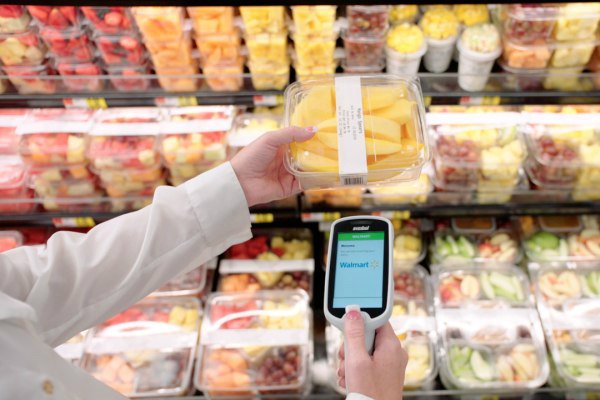
Customers only need to use the QR code reader to capture the origin of the mango slices sold in Walmart's supermarkets. Photo: Walmart
So, if a mango being sold is contaminated, Walmart will quickly track which farm it is grown in and in which region. Walmart will then verify if the mango was contaminated from that farm or during shipping. If the source of the infection is from a particular farm, instead of recalling all the mangoes and disposing of them, Walmart only needs to recall the mango that came from the farm where the infection occurred. Other types of mango remain on the shelf and this avoids huge food waste and saves recovery costs.
A report by the Food Marketing Institute and the Association of Food Manufacturers (USA) said that the average cost per food recall in the US costs about 10 million USD, which is not including the loss. brand damage and potential sales. Several large-scale food recalls could cost up to a billion dollars, such as the salmonella-infested peanut killing 9 people in the US in 2008-2009, prompting hundreds of companies to recall. peanut butter products, costing one billion US dollars.
In the case of an easy-to-access and check-in food traceability system that can be built using blockchain technology, reducing the time it takes companies and regulators to trace of contaminated food and quickly control the spread and limit the number of affected consumers.
Prevent food fraud
Food frauds (poor quality or counterfeit) cost the global food industry about 40 billion dollars a year, according to a report by the auditing firm PwC. Blockchain technology can help prevent food frauds by providing customers with transparent intelligence about the origin of food.
At the end of April, e-commerce group Alibaba (China) and its four partners include Australia Post, the food supplement company Blackmores (Australia), postal company New Zealand Post, and Fonterra and (New Zealand) milk have introduced a food traceability system using blockchain technology, allowing customers to capture the supply chain of food sold on Alibaba's e-commerce platforms, thereby , help prevent counterfeiting.
This system uses a public ledger to help end-to-end supply chain traceability to enhance consumer confidence and build a reliable cross-border trading environment.
With this system, customers purchasing Blackmores fish oil products and Fonterra's Anchor branded dairy products on Alibaba's Tmall Global e-commerce platform can check every process in their supply chain. using a mobile phone to scan the QR codes that are stuck on them. Alibaba said it will adopt this food supply chain traceability system for many items in the future.
Help farmers get paid faster
About 1.5 billion families around the world make a living by farming on a small scale. But a problem that many farmers have is that after delivering agricultural products to buyers, they have to wait weeks or even months for payment. This makes their life more difficult. Therefore, many companies have developed blockchain-based applications to provide near-instant peer-to-peer payment remittances (direct payments, not through third parties such as banks). between farmers and buyers of agricultural products.
For example, start-up AgriDigital (Australia) uses the world's first unified commodity transaction management platform, helping to connect farmers, shoppers and intermediaries storing goods. . The platform works on blockchain and cloud computing, supporting immediate payments to farmers once their produce is confirmed to be transferred to the warehouse and ownership of the produce is transferred to farmers. buy. This payment process is done thanks to an Agridigital smart contract that automatically evaluates the goods to be delivered, verifies the buyer has enough payment amount, holds the amount for the farmer while waiting for delivery and payment to farmers when the goods are delivered.
In 2016, AgriDigital made the world's first real-time commodity payment transaction. Using AgriDigital's commodity transaction management platform, David Whillock, a wheat farmer in New South Wales (Australia), delivered 23 tons of wheat to Fletcher International Exports and he was paid after about an hour of delivery.
To date, more than 1,300 customers use AgriDigital's commodity transaction management platform and more than 1.6 million tons of food are traded through the platform. AgriDigital has also helped pay out A $ 360 million to the farmers.
Many challenges
The enormous benefits that blockchain technology brings to the agriculture industry are clear. However, any technological transformation has its challenges and downsides.
For blockchain technology to be effectively deployed, it requires all stakeholders in the food supply chain to adopt the technology, but not all companies in the supply chain are proficient at it.
The first requirement is a reliable internet connection. However, this is not a viable option for many farmers living in rural areas, especially in developing countries. That's not to mention many farmers who are still skeptical of blockchain technology. In addition, regulatory differences could also prevent blockchain technology from being used by international food and beverage companies.
While blockchain technology can prevent fraud, digital transactions are still vulnerable if they become targeted by hackers. Any device (computer, laptop, mobile phone) in the blockchain system is also a potential source of vulnerability to hacker threats such as weak passwords.
Synthesis: Nguyen Thi Thuy

.jpg)

